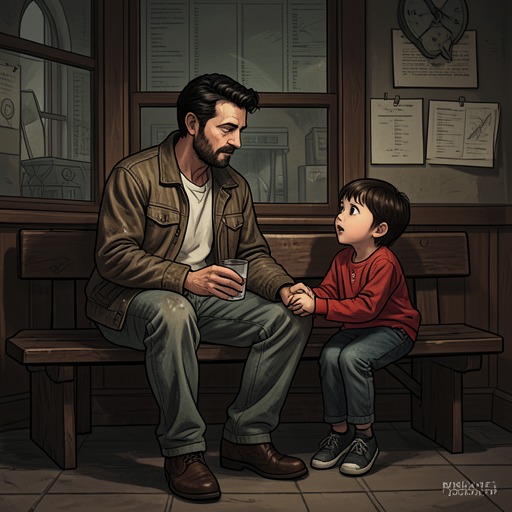
Gerry and Stella Gilmore’s marriage
Midwinter BreakGerry and Stella Gilmore’s marriage is the quiet pressure beneath their winter visit to Amsterdam: a durable partnership whose familiar ease conceals deep disagreements about faith, alcohol, aging, and how the remaining years should be lived. The four-day trip gives them time to take stock, but not a shared answer. Their marriage holds companionship and tenderness alongside habits of avoidance, and Stella’s emerging wish for a different life makes that tension newly explicit.
Early Courtship and Unequal Histories
Stella recalls the beginning of their relationship while standing in Amsterdam, remembering a time when Gerry could sweep her away. They drove in his car along the twisting east coast road through the Glens of Antrim toward Ballycastle. She was shy at first, smoked to keep him company, and spent the journey talking with him about politics, religion, and their families. This recollection presents their early closeness as an exchange: each learned the other’s history, and the journey itself carried the promise of discovering a larger world together.
Their backgrounds were sharply different. Stella was one of six children in a small village house without running water or an indoor toilet; each morning she carried water from the street pump. Her family hoped for a council house with four bedrooms, a bathroom, and two lavatories, and prayed together through a novena of Masses. Her mother also secretly threw a miraculous medal into the future garden. The house went instead to a Protestant policeman, a widower and sergeant in the Royal Ulster Constabulary, amid a council Stella remembers as Unionist. This childhood account is not simply a contrast to Gerry’s more comfortable circumstances: it brings the religious practice and sectarian discrimination that shaped Stella into the history of their courtship. Their early conversations encompassed these differences, though the marriage years later do not show them resolved.
Familiarity, Companionship, and Avoidance
In retirement the couple can seem safe, easy, and thoroughly accustomed to each other. Their banter gives that familiarity a double edge. Gerry makes alcohol sound like a buffer between himself and danger; Stella accepts the joke, but reframes what sustains them as the two of them. She then describes them as fortunate to have each other to ignore. The exchange is affectionate, yet its punchline names a way of living together in which company and withdrawal coexist.
The trip sharpens the gap between their shared routine and their differing needs. Stella is tired of living as they do and raises questions about how they might live well. She wants to recover a word from her childhood, devout, and to pursue a life shaped by charity and prayer. She understands this as something she must explore for herself, especially because Gerry is not a believer. Her wish is not presented as a simple accusation or an announced end to the marriage; it is a demand for an independent spiritual life that their familiar arrangement has not provided.
Intimacy and the Unspoken Divide
Their physical intimacy has not disappeared. When Gerry reaches toward Stella, he pauses with his hands raised as if unsure what to do; he then touches her, in a gesture likened to the husband in The Jewish Bride. They make love, and afterward he puts his arm around her. The scene gives their marriage a real tenderness, but not an easy reconciliation: bodily closeness remains possible while the questions Stella has raised about belief and the shape of their lives are still open.
Stella’s reflections make clear that she has begun to measure their marriage against the time left to them. She says she has been marking time: the children are grown and the work is done, yet perhaps ten or twenty years remain. She feels that the pattern of their lives has been cut wrongly and no longer fits her, while admitting that she does not know whether Gerry feels the same. His shrug and subsequent confusion leave her concern without a mutual definition. What she can articulate is a mismatch between the life they have made and the life she now wants; what Gerry understands remains uncertain.
Separate Futures, Age, and Care
Stella investigates whether she might live at the Begijnhof, but learns that its religious character has largely disappeared and that the waiting list may be five years or more. Residence is limited to women prepared to live alone, aged thirty to sixty-five, and able to afford it. Stella is too old to qualify. The practical barrier gives force to the question of separation: the independent life she is considering cannot simply be entered through the community she has sought out.
That disappointment does not end her imagining. She considers selling the couple’s flat and buying two small flats, one with a garden for herself. Yet even as she plans where Gerry might live and how he might manage meals and his belongings, she recognizes that she is organizing and caring for him again. The impulse shows how thoroughly their lives remain entangled, even as she tries to picture them apart. Independence is not yet freedom from the habits of marriage.
Aging further unsettles the balance between them. Stella notices red marks on her thighs and realizes that they are the prints of her elbows from leaning over while weeping. The discovery turns physical detail into a record of distress, while her tears about being too old bring back childhood memories and the accumulated years of her life. She worries about memory loss because she has seen her mother and grandmother deteriorate in old age; keeping up with crosswords is part of her effort to keep her mind active. She also sees Gerry forgetting not just words but whole conversations, including what they are having for dinner or plans to attend a reception. His lapses make their future more precarious, while her awareness of them sits beside her wish not to keep managing him.
The marriage is therefore neither reduced to its crisis nor secured by its long history. Its early curiosity survives in Stella’s memory, and touch and concern persist in the present; at the same time, she seeks a devout life of her own, considers living separately, and recognizes how care can reproduce the very arrangement she questions. The supplied episodes do not settle what the couple will decide. They leave the marriage suspended between attachment and divergence, with the remaining years no longer something Stella can accept as an unexamined continuation.